Locality of Reference is a critical Computer Science topic, and it helps improve your software’s performance if you, the programmer, are aware of it.
Programs that tend to exhibit good locality are those constituted of components that tend to reference data items that are near other recently referenced data items, or that were recently referenced themselves.
The two types of locality
-
Temporal locality: if a main memory word is referenced once, and there are potential references in the near future, it should be in the cache memory.
-
Spatial locality: if a memory location is referenced once, then the program is likely to reference a nearby memory location in the near future. A good example is a programming block which is logically distinguishable, that is: traversing a contiguous array of data using a loop statement.
Okay, thank you for giving me information I can get from Wikipedia. How the heck will that help me improve my programming skills and performance?
Answer: we have the following example that performs a matrix values sum.
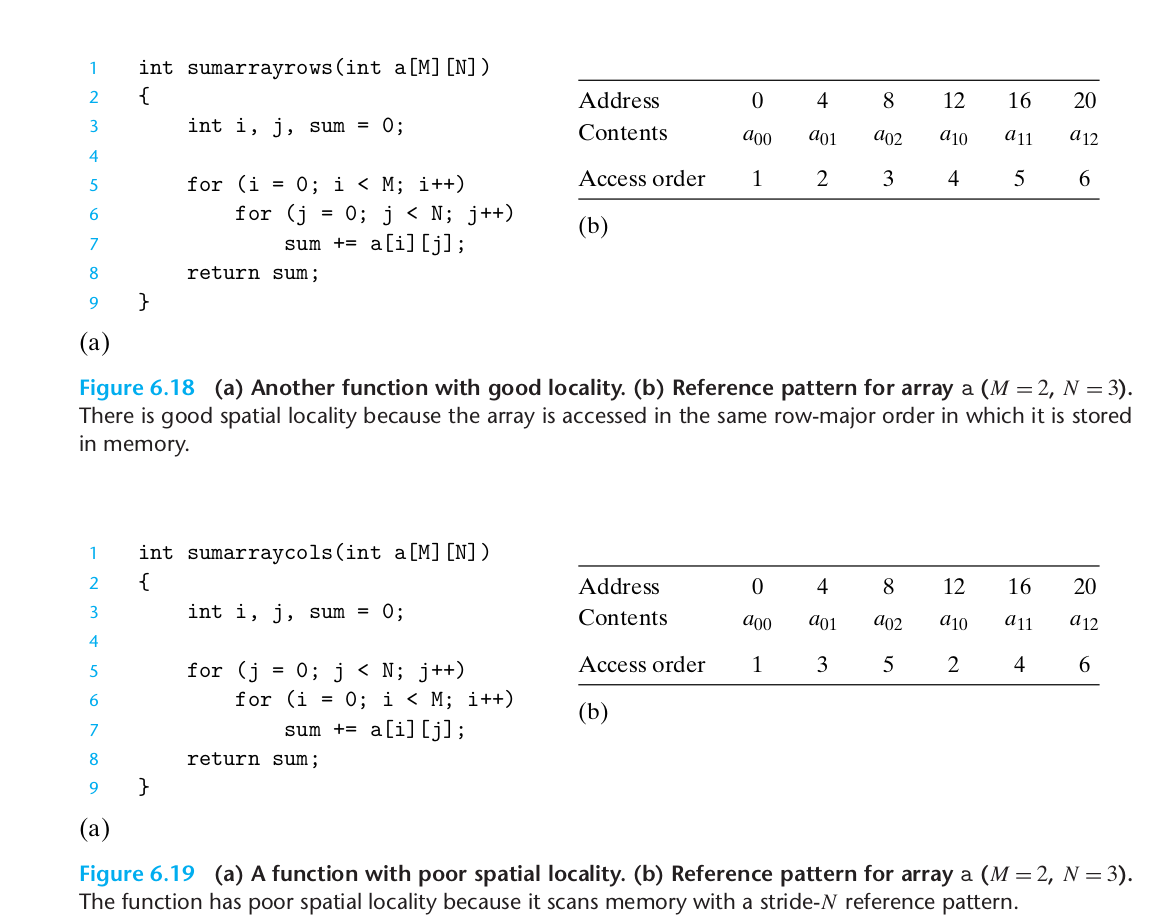
The sumarraycols() function in Figure 6.19(a) computes the same result as the sumarrayrows() function in Figure 6.18(a). The only difference is that we have interchanged the i and j loops.
But what impact does interchanging the loops have on locality?
The sumarraycols() function suffers from poor spatial locality because it scans the array column-wise instead of row-wise, since C arrays are laid out in memory row-wise.
The examples are retrieved from the book: Computer Systems - A Programmer’s Perspective.