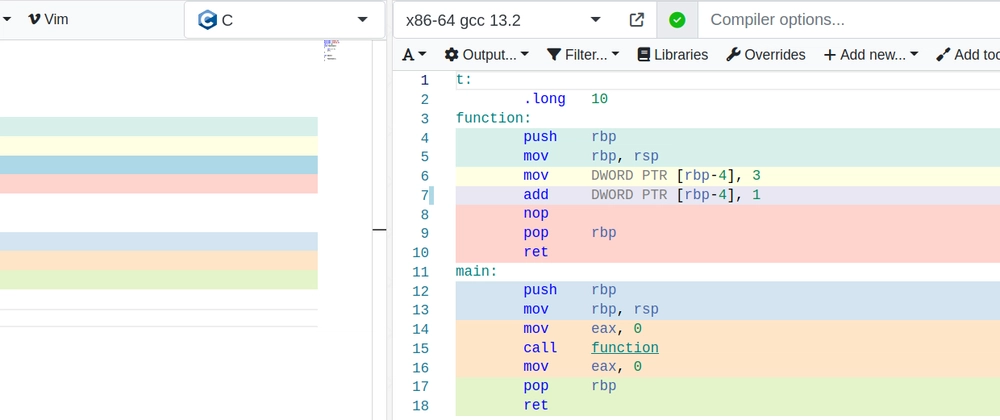
Because I always forget how the kernel is handling the program’s functions in the call stack, I’ll write about it so I can come back after months, or someone else will :)
So hello, let’s do it in C on an x86-64 bits machine. Why? Because it’s my favorite language.
From C to assembly
First, when you compile your C code:
gcc -c main main.c
you get an object file main.o that will be linked later (manually or dynamically) with other already compiled standard code (like your famous printf()), and you get an executable file, ELF64 in my case.
When you disassemble it, either with objdump or gdb, you can see the assembly code of your program:
gdb ./main
disassemble function
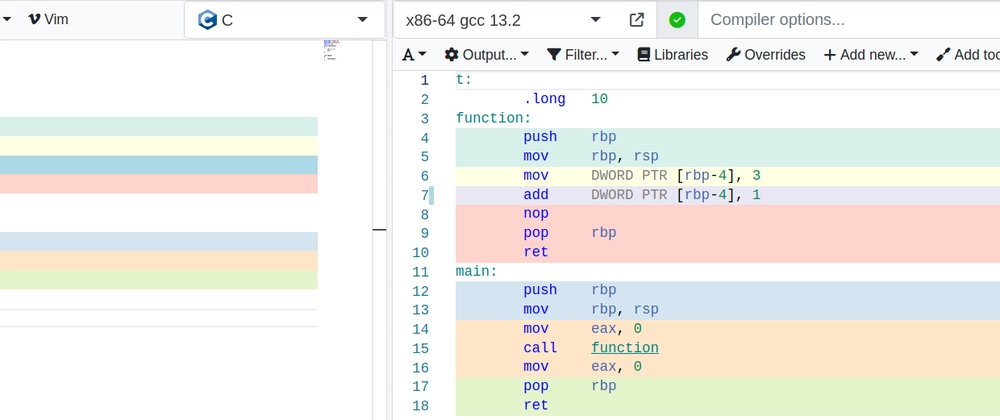
You’ll find some sections like .text, .bss or .data, the heap, and the stack. These are the sections of the virtual address space of your program.
What concerns us is the .text section: it contains the code, the instructions to be executed. For example int x = 3 will have the equivalent of movl $0x3,-0x4(%rbp).
Okay, good. What concerns us now is how the functions main() and function() are handled in the stack, the section where the functions reside.
The registers involved
The CPU has some special registers called %rbp and %rsp (the base pointer and the stack pointer) to manipulate the scope of the functions:
%rbpis used to access the memory words by adding values to it, like the example we had:movl $0x3,-0x4(%rbp)%rspalways points to the top of the stack.
The function prologue
Here is the process, step by step:
-
The first thing we need to do is push the value of the old
%rbp, because it’s used by other functions to do the same thing. In this case that’s themain()function, which calledfunction(). -
Then we push the return address to the stack, so the
main()function resumes its execution where it stopped (in this case it will return to line 13). This information is retrieved from registerr14in ARM processors, for example. -
Then we’ll set the new value of the base pointer
%rbp(the one we said is used for accessing memory words in the scope) to the value of%rsp, so the top of the stack.
This process of handling %rbp and %rsp is called the function prologue, and it’s done at each function start, as you can see in the assembly code.
This is how the initialization of the function scope is done, similarly across multiple architectures and systems.
Calling conventions
Now we’ll use the function call stack by putting the local variables, the function parameters, etc. These specific details follow calling conventions:
One of the conventions to follow on x64 architectures, for example, is System V. For function parameter handling, the registers are used like this: the first parameter is placed in rdi, the second in rsi, the third in rdx, and then rcx, r8 and r9. Only the 7th argument and onwards are passed on the stack. The left most parameter is passed first on the stack, then the old value of the base pointer, and then it’s followed by the local variables of the function.